 Issue 44 Issue 44
Features reviews by Kathleen Broderick, Linn Miller, Christine Choo, Bill Thorpe, David Ritter, Eve Vincent, Stephanie Bishop, Alison Miles, Richard Kay, Amanda Day, Bernard Whimpress, Mads Clausen, Marion May Campbell, Sylvia Alston, Catie Gilchrist, Eva Chapman, Lucy Dougan, Stephen Lawrence and Nathanael O'Reilly. Click here for more details.
|
 Popular Music: Practices, Formations and Change - Australian Perspectives Popular Music: Practices, Formations and Change - Australian Perspectives
The papers collected here in this special edition of Altitude offer a brief snapshot of popular music research broadly connected with Australia. The essays demonstrate the variety of theoretical and methodological approaches used by researchers in the fields of popular music studies and cultural studies to explore themes of popular music practice, formation and change in an Australian context. Click here for more details.
|
|
News
New Literature on Search Engine Optimization  The first thing you need to learn about Search Engine Optimization is that it's necessary in this day and age for any kind of business. Writers need to use SEO to build a fan base in their genre, business need SEO in order to be able to promote their ...
Click here to read more.
|
More News
Gambling in Culturally Diverse Communities in Australia  Australia is undoubtedly one of the most diverse countries in the world, linguistically- and culturally-speaking. Native Australians come from more than 250 ancestries and, according to the 2007 “Census of Population and Housing” via the Australian Bureau of Statistics (ABS), speak nearly 400 unique languages at home ...
Click here to read more.
|
Network Scholars
Top 5 Contemporary Young Adult Authors from Australia Vanessa Evans and Jason Sternberg Melina Marchetta is commonly referred to as the Queen of Australian Young Adult Contemporary Fiction. Melina Marchetta’s first breakthrough happened back in 1992 with the release of the novel Looking for Alibrandi. Later on, she wrote the screenplay for the film based on the book. She received awards for both the novel and the screenplay
... Click here to read more.
| Network Review of Books
Litigation: Past and Present (2004) Reviewed by Mark Finnane in the September 2004 issue. Reviewed by Mark Finnane in the September 2004 issue.The legendary litigious character of American society is commonly regarded as an example to be avoided in Australia. The collapse of the private medical insurer, United Medical Protection, in 2001 prompted widespread media and political attention in Australia to what was described as a 'litigation crisis'. As Ted Wright and Angela Melville show in their lively treatment of civil litigation trends in this book, such a crisis was likely generated by something other than the trends in personal injury litigation in NSW which drifted downwards in the five years before the 'crisis'. In a phenomenon ... read more.
The Taste of Memory: Food and gardens have taken Marion Halligan to some surprising places... (2004) Reviewed by Sylvia Marchant in the March 2005 issue. Reviewed by Sylvia Marchant in the March 2005 issue.Marion Halligan is an accomplished writer who needs no introduction to an Australian audience as her novels, short stories and non-fiction works, especially those about food, are well known and admired. She is indeed an Australian icon. Halligan's first published works were about food and here she returns to her favourite theme, taking a trip down memory lane in the tradition of memoir, a memoir framed by meditations on food, wine, gardens, life, and art, themes which have pervaded her life and experience. There are philosophic meanderings and reflections on such things as possessions, ... read more.
More or Less Than (2004) Reviewed by Carolyn van Langenberg in the April 2005 issue. Reviewed by Carolyn van Langenberg in the April 2005 issue.On the morning I had set aside to read <More Or Less Than> 1-100 I was listening to Radio National's Law Report in which Julie Clarke, lecturer in law at Deakin University, argued for the legalisation of torture. Beatings conducted according to the ordinances after the Act with a medical practitioner present, so Clarke believes if my ears did not deceive me, would not damage health, mental or physical. Her assertion lashed 'like the leashes which bind answers to their questions' ('32' p 38). What music then to read 'not simply the stream but they who thought of following' ('1' ... read more.
The Prickly Pair: Making Nationalism in Australia and New Zealand (2004) Reviewed by Graham Willett in the April 2005 issue. Reviewed by Graham Willett in the April 2005 issue.Those of us alert to the emergence of new fashions in our disciplines will be -- almost regardless of what our discipline is -- aware of the recent rise of transnationalism. In Australian history, in particular, it is starting to make a name for itself, being taken up by several prominent scholars. This is a welcome development. It has always been clear that Australia cannot be understood without reference to the rest of the world, and there has been a long history of our understanding ourselves and our development as a nation and a society in relation to others -- Britain, of course, the ... read more.
The Diaries of Miles Franklin (2004)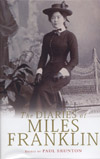 Reviewed by Deborah Jordan in the May 2005 issue. Reviewed by Deborah Jordan in the May 2005 issue.Miles Franklin embodies a significant strand of Australian feminism. My Brilliant Career -- or My Brilliant (?) Career as she wanted it known -- is a national icon. The importance of Franklin's diaries cannot be overstated, and Paul Brunton's selection is beautifully edited, annotated, and illustrated. Many of the people referred to in Franklin's diaries have been painstakingly identified, a crucial task. The first question readers might ask is why the selection is only from 1932 to 1954, from when Franklin returned to Australia, permanently, at the age of fifty-three. Is the title of ... read more.
Sex and Money (2004)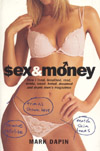 Reviewed by Dean Durber in the February 2005 issue. Reviewed by Dean Durber in the February 2005 issue.Is Mark Dapin serious? Is he for real? He promotes himself as a 'socialist', concerned with the plight of the world, just a poor boy from England living in the middle of two broken homes--a true working class wannabe liberationist, but, turn a page or two, and suddenly he is enthroned as editor of a magazine that publishes pictures of naked women for the masturbatory pleasures of...men (he assumes). Now where is the revolution in that? Perhaps this is the dilemma of Mark and his life story. Perhaps his twisted, schizophrenic view of work and life seeks to explain, 'How I lived, breathed, ... read more.
|
|

|


 About the Network